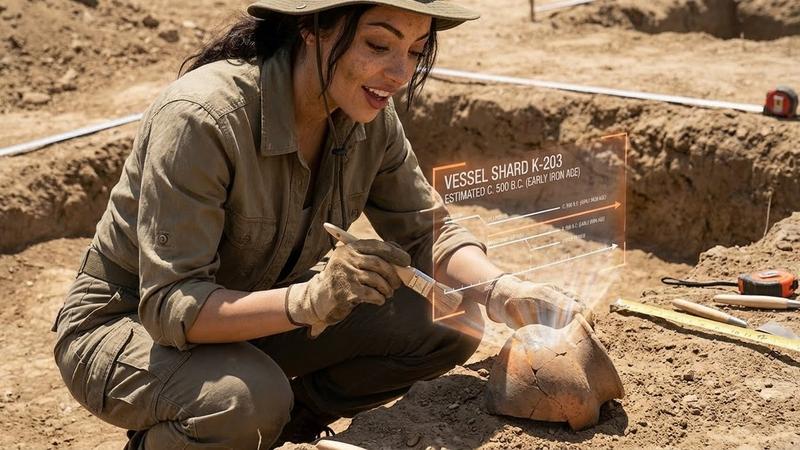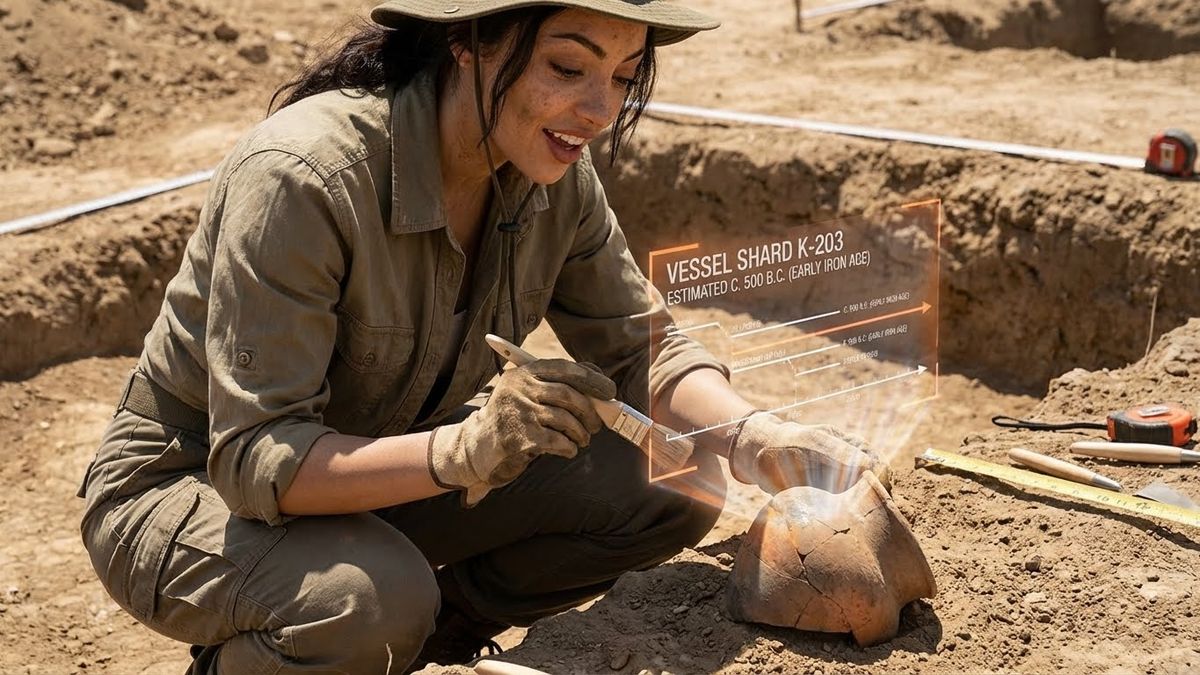
考古挖掘场景中查看3D时间线和数据叠加的文物
Prompt
Nano Banana Pro Prompt:
{
"promptDetails": {
"description": "An archaeological dig scene where the subject is viewing a 3D timeline and data overlay projected onto a recently uncovered artifact.",
"styleTags": [
"Archeology",
"Earthy Textures",
"Academic/Documentary",
"Dry and Dusty"
]
},
"scene": {
"background": {
"setting": "An active archaeological trench in a dusty, sun-baked desert environment",
"details": "Brushes and small tools visible, measuring tapes and grid markers in the soil, exposed layers of earth, a recently uncovered ceramic shard/pot."
},
"subject": {
"description": "The person defined by `[UPLOADED IMAGE]`, wearing field clothes and perhaps a brimmed hat, looking excited and careful.",
"pose": "Crouching down in the trench, holding a small brush near the artifact, looking intently at the projection.",
"focus": "The artifact and the projection are the key points of visual interest."
}
},
"overlayObject": {
"type": "3D Timeline and Data Projection",
"relationshipToEnvironment": "A semi-transparent, three-dimensional graphic emanating directly from the surface of the ceramic pot, showing its timeline.",
"transform": "A series of floating text labels and lines showing dates and cultural periods, seemingly anchored to the artifact.",
"surfaceInteraction": "Faint, slightly flickering orange/white text and lines that look \'hot\' or energized, contrasting with the dry earth.",
"components": {
"artifactID": "Vessel Shard K-203",
"dating": "Estimated C. 500 B.C. (Early Iron Age)",
"position": "Emanating from and hovering around the pot."
}
},
"technicalStyle": {
"aspectRatio": "5:4 (Portrait)",
"photographyStyle": "Documentary, High Contrast",
"camera": {
"shotType": "Close-Up",
"angle": "Low to the ground, capturing the detail of the soil and the artifact.",
"depthOfField": "Shallow, focusing tightly on the subject\'s hands, the artifact, and the projection."
},
"lighting": {
"type": "Harsh, Overhead Daylight",
"description": "Strong, high-angle sun casting short, dark shadows, emphasizing the dry, dusty nature of the scene."
},
"color": {
"palette": "Monochromatic earth tones (browns, tans, desaturated oranges), contrasted by the bright white/orange of the projection."
}
}
}- Category
- Photography & Realism
- Model
- Nano Banana Pro
- Creator
- HBCoop_
- Source ID
- archaeological-dig-scene-with-3d-timeline-and-data-overlay
Views0