死亡之建筑的永恒循环
提示词
The Architecture of Mortality
One prompt to capture the eternal cycle.
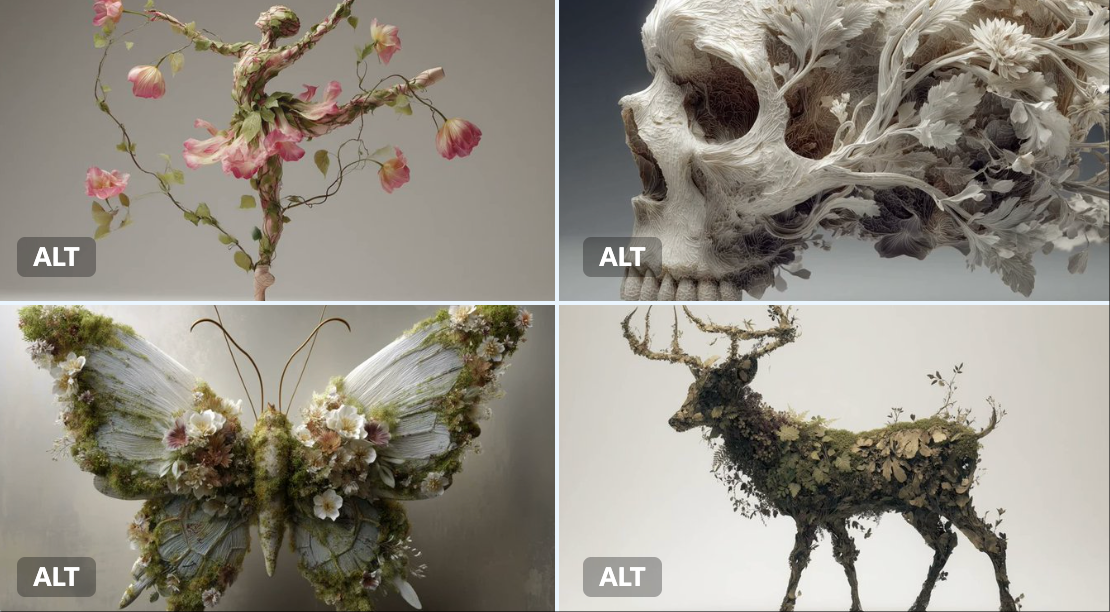
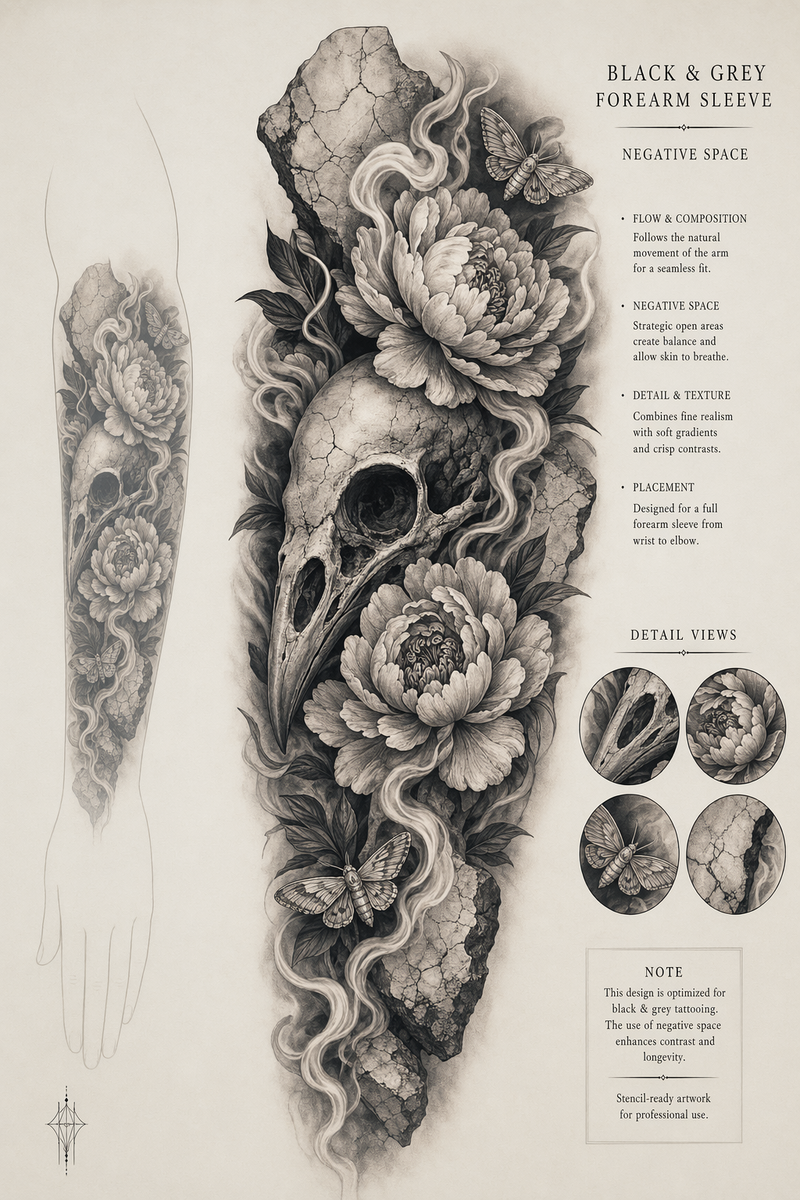
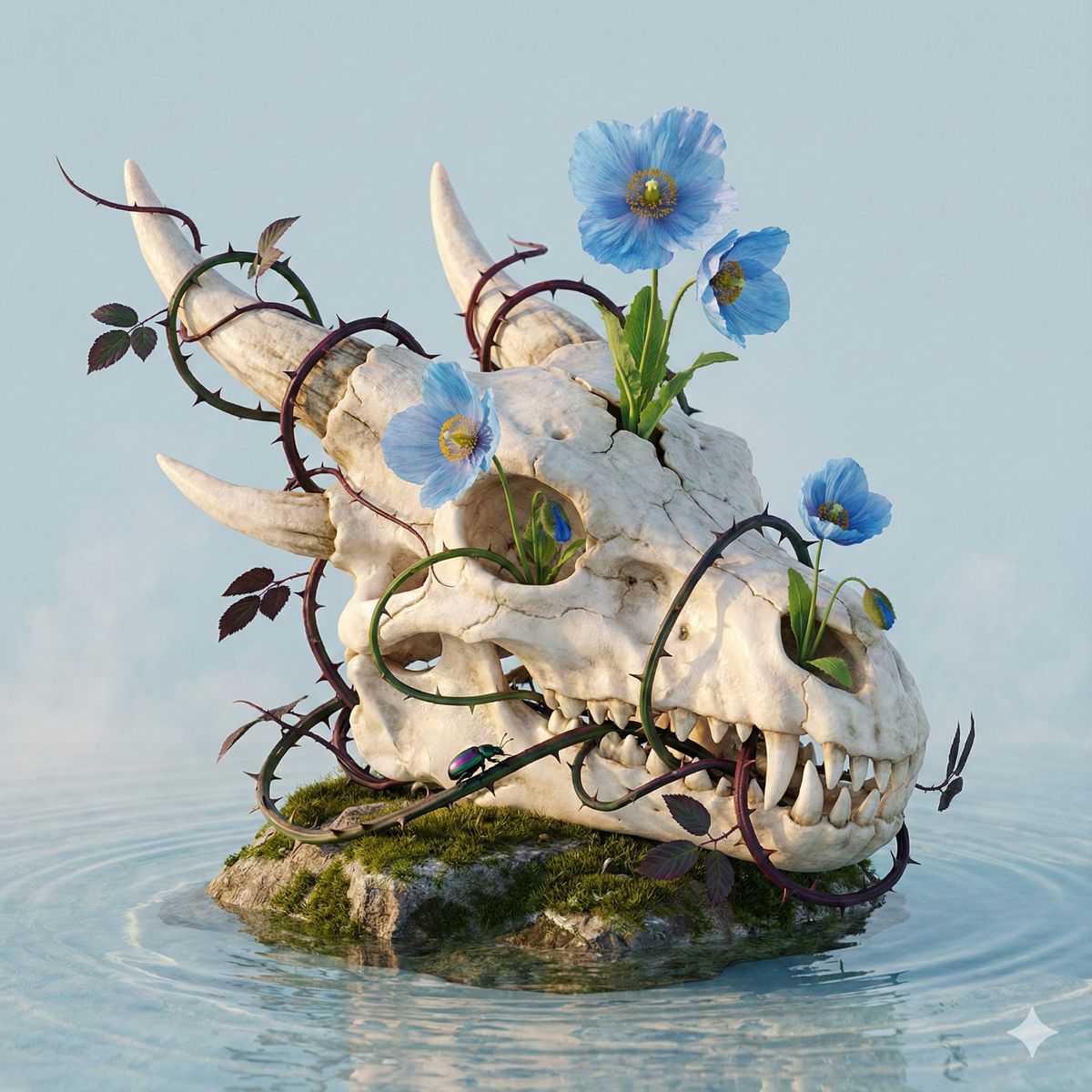
Death becomes fertile ground. Ancient bone meets living bloom. Thorny decay coils the surface. Vibrant renewal pierces through cavities. Weathered skulls breathe new life, mythic resonance materializing as tangible beauty.
Dragon skulls wreathed in blue poppies. Ancient bovine crowned with spider lilies. Or let the template infer its own mythology.
Nano Banana Pro Prompt ⬇️
## Subject:
Mythical [SkullType] skull as central anchor, resting on small earth mound, moss patch, or rock surface that rises slightly above shallow water—skull itself remains dry and elevated while water surrounds the base with gentle ripples. Alternatively, minimal moss patch with soft-edge fade on dry ground (avoid hard borders or defined ground plane).
Two distinct botanical elements:
1. Thorny brambles (wild, non-flowering vines)—dark, woody tendrils with sharp thorns coiling around skull exterior, wrapping horns/bone ridges, emphasizing weathering and decay. Minimal leaves, dark greens/burgundy tones. These do NOT produce flowers.
2. [Flower] plants (separate species)—vibrant flowering stems growing independently through major skull openings (eye sockets, nasal cavity, cranial fissures, jaw gaps). [Flower] blooms emerge from these growth points—crown, jaw, or penetrating through skull dome. Single flower species throughout (maintain botanical consistency and anatomical accuracy). Vary bloom scale to create visual hierarchy (1-2 prominent focal blooms, supporting smaller flowers). These plants have their own stems and leaves, distinct from thorny brambles.
[Creature] (as needed) integrated as living accent—coiled around bone structures or nestled within vegetation.
Style & Medium:
Adorable 3D render (C4D aesthetic) or high-fidelity photography style.
CRITICAL: Full PBR material—achieve tangible depth through:
- Accurate subsurface scattering on petals and translucent elements
- Realistic ambient occlusion and global illumination
- Natural specular reflections based on surface properties (bone roughness, water glossiness, petal velvet)
- Detailed micro-surface variation and weathering
- Soft depth of field to enhance spatial hierarchy
Rich tactile quality with organic imperfections. Subtle film grain or sensor noise for photographic authenticity.
Composition:
Grounded composition with soft environmental integration—skull rests on small elevated platform (earth mound, moss-covered rock, or stone) rising above shallow water that creates gentle ripples around the base. Alternatively, minimal moss patch on dry ground with soft gradient fade (no hard edges or defined ground plane). Platform/water transitions seamlessly into clean gradient background.
Asymmetric balance: skull anchors one side, floral growth extends as counterweight. Progressive depth through:
- Thorny brambles coiling around/across bone surfaces (background/mid-ground layer)
- Flower stems emerging through skull openings (foreground layer)
- Bloom distribution and atmospheric perspective
Camera:
Medium-wide framing capturing full skull form with surrounding growth—ensure all primary elements (skull, major blooms, stem structures) remain unclipped within frame. Three-quarter or side angle view. Slight low angle to emphasize monumentality.
Lighting & Color:
Bright, diffused natural light suggesting late afternoon/golden hour—prioritize high luminosity to ensure subject visibility and visual appeal.
Color palette bridges death and life:
- Skull: luminous weathered bone whites, ivory, light cream tones (avoid heavy shadowing)
- Thorny brambles: dark woody browns, deep forest greens, burgundy/wine tones—emphasize shadow and decay
- Flower stems: contextually appropriate to [Flower] species—fresh greens, herbaceous tones
- Flowers: vibrant, saturated naturalistic blooms (accurate to [Flower] species)—provide vivid color contrast
Background: highly luminous, desaturated gradients—pale sky blue, soft aqua, or near-white with subtle cool blue undertones (when water present); alternatively pale warm beige/cream (dry ground context). Cool blue tones enhance water clarity and create clean, ethereal atmosphere. Prioritize brightness and low saturation for maximum clarity and airiness. Avoid ground textures, horizon lines, or muddy elements.
CRITICAL: Strong key lighting with soft fill to eliminate murky shadows. Generous rim lighting on bone edges, petal tips, and stem silhouettes to enhance readability and visual appeal.
Detail & Texture:
Bone: advanced weathering with deep micro-cracks, highly porous calcium surface, lichen patches with color variation, erosion grooves revealing bone layers. Select areas show severe degradation—thinned bone structure with translucent quality, small fragments missing, emphasizing temporal decay and passage of time since death.
Thorny brambles: gnarled woody bark texture, sharp thorns with realistic points, twisted organic growth, minimal dark foliage, emphasize age and wildness
Flower stems: anatomically accurate to [Flower] species—herbaceous or woody depending on type, fresh texture contrasting with brambles
Flowers: layered petals with subsurface scattering and natural translucency, visible stamens and pistils, species-accurate leaf structure with vein details, dew droplets with refraction (as needed)
Water (if present): crystal-clear shallow water with accurate refraction, gentle concentric ripples with realistic surface tension, soft reflections, caustics on submerged surfaces
Creature (as needed): realistic scale/fur microstructure, jewel-toned iridescence with shifting highlights
Grain: subtle film grain or sensor noise for photographic realism
Mood:
Quiet reverence. Not morbid—transformative. The skull is honored monument, the blooms are gentle reclamation.
## Narrative Guidance
All visual elements emerge from the thematic core: death as fertile ground for new life. Brambles embrace decay (coiling bone surfaces), flowers transcend death (pushing through cavities). Creatures (if present) as vitality accents, not focal subjects.
Critical separation: Brambles do NOT flower. Flowers do NOT have thorny stems (unless species-accurate like roses).
## Variable Defaults
[SkullType]: Dragon or mythical beasts
[Flower]: Himalayan blue poppy, corn poppy, or red spider lily
[Creature]: (Optional) Serpent, moth, beetle, or poison dart frog
ar=1:1
Xenomorph https://t.co/z1F9O2GB0D
- 分类
- 真实摄影
- 模型
- Nano Banana Pro
- 来源作者
- Jerlin
- 来源 ID
- eternal-cycle-of-architecture-of-mortality
浏览量0