Geological Strata Cross-Section
Produce a detailed geological cross-section poster of layered earth strata cutting through a fictional canyon basin. Use a natural scientific palette of sandstone beige, iron oxide
- 分类
- 图表信息图
- 模型
- GPT Image 2
- 来源作者
- wuyoscar
- 原始语言
- en
- 来源 ID
- 128
完整提示词
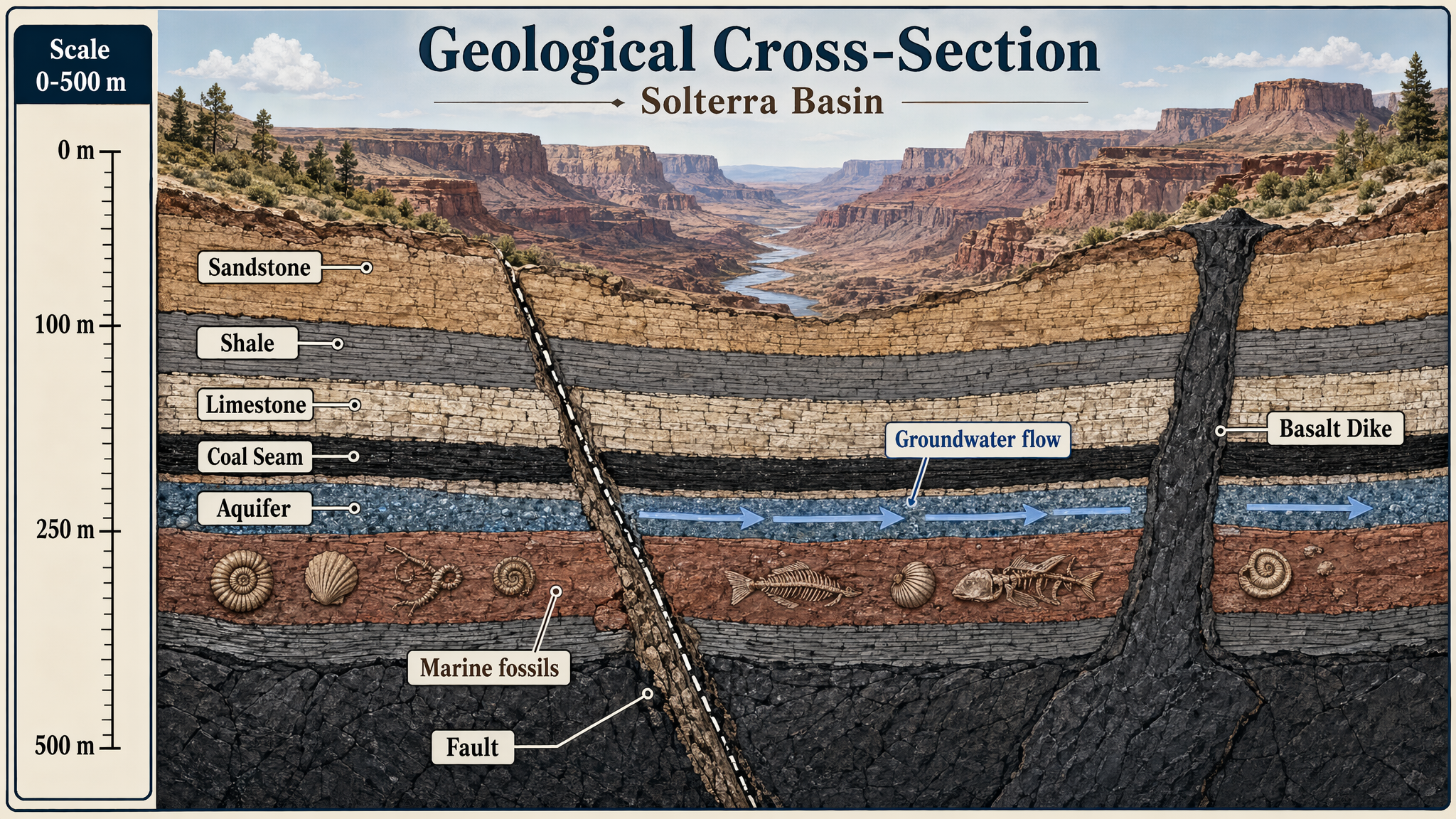
Produce a detailed geological cross-section poster of layered earth strata cutting through a fictional canyon basin. Use a natural scientific palette of sandstone beige, iron oxide red, shale gray, limestone cream, basalt charcoal, and muted green vegetation above ground. Show clearly differentiated layers, a fault line, an aquifer, fossil-bearing beds, and a volcanic intrusion. Add crisp in-image text: "Geological Cross-Section", "Solterra Basin", "Scale 0-500 m", and labels "Sandstone", "Shale", "Limestone", "Coal Seam", "Aquifer", and "Basalt Dike". Include a vertical scale with "0 m", "100 m", "250 m", and "500 m". Add small annotations "Marine fossils" and "Groundwater flow" with arrows. The composition should be highly legible, educational, and neatly diagrammed, with clean linework, correct label placement, balanced annotation density, and publication-quality scientific illustration clarity.
多语言版本
Geological Strata Cross-Section
enProduce a detailed geological cross-section poster of layered earth strata cutting through a fictional canyon basin. Use a natural scientific palette of sandstone beige, iron oxide red, shale gray, limestone cream, basalt charcoal, and muted green vegetation above ground. Show clearly differentiated layers, a fault line, an aquifer, fossil-bearing beds, and a volcanic intrusion. Add crisp in-image text: "Geological Cross-Section", "Solterra Basin", "Scale 0-500 m", and labels "Sandstone", "Shale", "Limestone", "Coal Seam", "Aquifer", and "Basalt Dike". Include a vertical scale with "0 m", "100 m", "250 m", and "500 m". Add small annotations "Marine fossils" and "Groundwater flow" with arrows. The composition should be highly legible, educational, and neatly diagrammed, with clean linework, correct label placement, balanced annotation density, and publication-quality scientific illustration clarity.